What Is Agentic AI? How AI Agents Can Work for Your Business
Discover how Agentic AI is changing business operations. Learn how AI agents work, how they differ from chatbots, and practical ways Ethiopian businesses can use AI automation.
8 min read
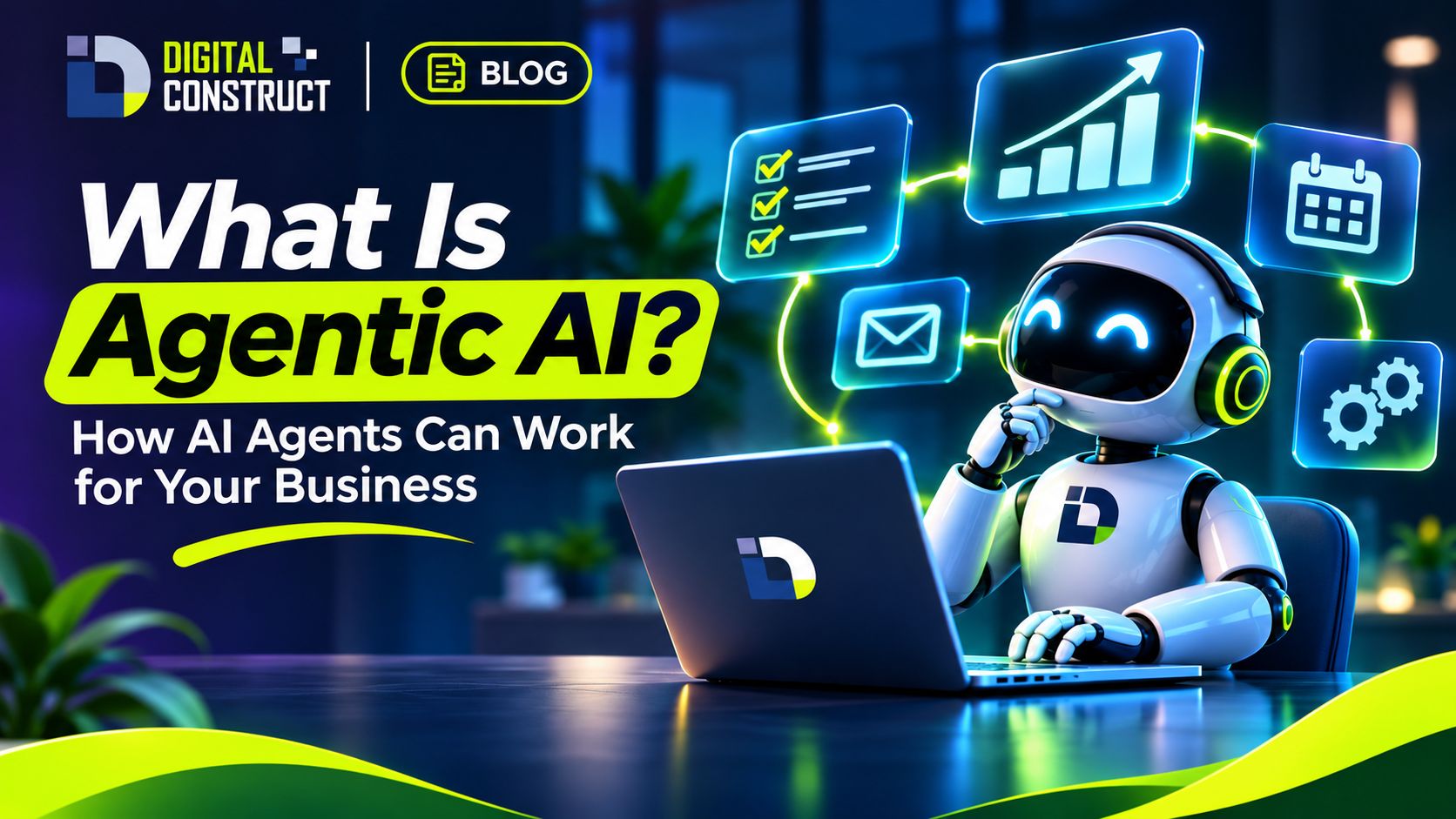
Artificial intelligence is moving beyond answering questions. AI agents can now use tools, perform tasks, and help businesses automate multi-step workflows. But how does this technology actually work?
Introduction: From AI That Answers to AI That Acts
Imagine receiving 100 customer inquiries every day.
Some customers ask about product prices. Others want to check order statuses, request quotations, or schedule appointments.
Traditionally, your employees would have to review these messages, find the necessary information, and respond individually.
A conventional AI chatbot might answer common questions. An AI agent, when connected to the appropriate business systems and given permission, can go further.
It could check inventory, retrieve an order status, prepare a quotation, or create a support ticket.
This is the promise of Agentic AI, one of the important developments in modern artificial intelligence.
For businesses in Ethiopia and around the world, AI agents offer new possibilities for reducing repetitive work and improving operational efficiency.
But understanding the technology is essential before adopting it.
1. What Is Agentic AI?
Agentic AI refers to artificial intelligence systems designed to pursue goals by selecting actions, using tools, and responding to information gathered during a task.
Unlike a basic chatbot that primarily generates answers, an agentic system may interact with software applications, databases, and external services.
For example, consider this instruction:
"Check which customer orders are delayed, prepare a summary, and notify our support team."
An appropriately configured AI agent might:
Retrieve recent orders from an order management system.
Identify orders that have passed their expected delivery dates.
Collect the relevant customer and order details.
Prepare a structured summary.
Send the summary to an authorized support channel.
Record the completed action.
These steps require integrations, permissions, and safeguards. Simply connecting a language model to a business does not automatically provide these capabilities.
The important difference is that the AI system is designed to perform a sequence of actions toward a defined objective.
2. AI Chatbots vs. AI Agents: What's the Difference?
The terms AI chatbot and AI agent are sometimes used interchangeably, but they describe different capabilities.
A basic chatbot is primarily designed to communicate with users.
An AI agent is designed to perform tasks, potentially involving multiple decisions and external tools.
FeatureBasic AI ChatbotAI AgentAnswer questionsYesYesAccess business informationWith integrationWith integrationPerform multi-step tasksUsually limitedYesUse external toolsSometimesCommonlyExecute authorized actionsSometimesYesAdapt its next stepsLimitedOften
These categories overlap. Some advanced chatbots include agentic functionality, while some AI agents operate behind the scenes without a conversational interface.
Practical example
A customer asks an electronics company:
"Do you have a 20,000mAh power bank available?"
A basic chatbot might provide general product information.
An integrated AI agent could query the company's live inventory system, confirm availability, and provide the latest authorized product details.
With additional permissions, it might also prepare an order for customer confirmation.
The result depends on how the system is designed and what access it has been granted.
3. How Do AI Agents Actually Work?
Many AI agents combine several components.
A. Artificial Intelligence Model
The model interprets instructions, processes information, and helps determine what action should happen next.
Large language models are commonly used for this purpose.
B. Tools and Integrations
Tools allow the AI agent to interact with other systems.
Examples include:
Customer relationship management platforms.
Inventory databases.
Email and messaging services.
Booking systems.
Enterprise resource planning software.
Document management platforms.
C. Business Knowledge
An AI agent can use approved company information to provide more relevant responses.
For example, it might access product specifications, company policies, frequently asked questions, or support documentation.
A technique called Retrieval-Augmented Generation (RAG) can help an AI system retrieve relevant information from approved knowledge sources.
D. Workflow Logic
Workflow rules define which tasks the agent can perform, when it should request clarification, and when it must stop.
E. Human Oversight
Human approval is especially important for sensitive actions.
An AI agent should not independently approve significant payments, disclose confidential customer information, or make high-impact business decisions without appropriate authorization.
Reliable agentic systems require monitoring, testing, access controls, and clear escalation procedures.
4. Seven Practical Ways Businesses Can Use AI Agents
1. Customer Support Automation
AI agents can help businesses manage common customer inquiries.
A properly integrated agent may retrieve order information, answer approved questions, categorize complaints, and create support tickets.
Complex or sensitive cases can be escalated to human employees.
2. Sales Lead Qualification
Businesses receive inquiries through websites, forms, and messaging platforms.
An AI agent can help organize leads by collecting requirements, identifying requested services, and preparing information for sales representatives.
For example, a software development company might use an agent to ask prospective customers whether they need a website, mobile application, or ERP system.
The agent can then prepare a structured project brief for the sales team.
3. Inventory Monitoring
Inventory management is essential for retailers, wholesalers, manufacturers, and distributors.
An AI agent connected to a stock management system can help identify low-stock products, prepare reorder suggestions, and generate inventory summaries.
Purchase decisions can remain subject to management approval.
4. Appointment Scheduling
Service businesses can use AI agents to help manage appointments.
With access to an approved scheduling system, an agent can check available time slots, propose appointments, and create confirmed bookings.
This may be useful for consulting companies, fitness centers, clinics, and training organizations.
5. Document Processing
Many organizations spend significant time manually processing invoices, forms, reports, and other documents.
AI-assisted workflows can extract information, classify documents, and prepare records for review.
Because AI extraction can make mistakes, important financial or legal information should be validated before use.
6. Employee Knowledge Assistance
Businesses often store important information across documents, internal systems, and shared folders.
An AI knowledge assistant can help authorized employees locate relevant policies, procedures, and operational information.
This can reduce time spent searching through multiple documents.
7. Reporting and Business Analytics
An AI agent connected to trusted reporting systems can help prepare summaries of sales, inventory, customer inquiries, and operational performance.
For example, a manager might ask:
"Summarize our sales performance this week and highlight products with declining sales."
The agent could retrieve the relevant data and prepare a draft report for review.
5. How Agentic AI Can Benefit Ethiopian Businesses
Ethiopian businesses operate across different industries, including retail, manufacturing, real estate, logistics, education, and professional services.
Many organizations still depend on manual processes, spreadsheets, disconnected software, and repeated administrative work.
AI agents may help improve these workflows when implemented appropriately.
Potential benefits include:
Reduced repetitive work: Employees can spend less time on routine information retrieval and administrative tasks.
Faster customer responses: Approved AI systems can help handle common questions outside normal office hours.
Better information access: Connected systems can make operational information easier to retrieve.
Improved consistency: Standardized workflows can reduce variation in how routine tasks are handled.
Scalable operations: Businesses may be able to manage increasing workloads without increasing manual effort at the same rate.
However, businesses must also consider internet reliability, software integration, data quality, operating costs, language requirements, and employee training.
AI adoption should begin with a clearly defined operational problem rather than adopting technology simply because it is new.
6. Can AI Agents Work in Amharic?
AI agents can be designed to support multilingual experiences, including English and Amharic.
For example, a business could develop an assistant that receives customer inquiries in Amharic and retrieves information from approved company records.
However, the quality of multilingual performance depends on the underlying model, available language resources, the complexity of the task, and testing.
Businesses should evaluate their AI systems using realistic local-language examples before deploying them to customers.
7. Are AI Agents Safe?
AI agents can introduce security and operational risks, especially when connected to important business systems.
Potential risks include:
Incorrect or fabricated responses.
Unauthorized access to sensitive information.
Prompt injection attacks.
Accidental execution of actions.
Incorrect decisions based on outdated data.
Excessive permissions.
Unexpected operating costs.
A safer implementation follows the principle of least privilege: an agent should receive only the permissions necessary for its assigned tasks.
Important actions should be logged, monitored, and subject to human approval where appropriate.
8. How Much Does It Cost to Build an AI Agent?
The cost of developing an AI agent depends on its complexity and operational requirements.
A simple knowledge assistant using approved company documents is generally less complex than an agent integrated with inventory, accounting, sales, and customer management systems.
Major cost factors include:
AI model usage.
Number of software integrations.
Development and testing.
Data preparation.
Security requirements.
Hosting and infrastructure.
Maintenance and monitoring.
Number of users and expected requests.
Instead of selecting an AI agent based only on its initial price, businesses should evaluate the total cost of ownership and the measurable value it can deliver.
9. How to Get Started With Agentic AI
Businesses interested in AI agents can follow a practical implementation process.
Step 1: Identify a repetitive problem.
Choose a process that consumes employee time or creates operational delays.
Step 2: Define a measurable goal.
For example, reduce the average time required to categorize customer support requests.
Step 3: Evaluate your existing systems.
Determine whether the required information is available through databases, APIs, or approved documents.
Step 4: Start with a limited pilot.
Test the AI agent on a clearly defined workflow before expanding its responsibilities.
Step 5: Keep people involved.
Require human review for sensitive, expensive, or high-impact actions.
Step 6: Measure results.
Monitor accuracy, response times, employee workload, customer satisfaction, and operating costs.
Step 7: Improve gradually.
Expand the system only after confirming that the initial implementation is reliable and useful.
10. How Digital Construct Helps Businesses Adopt AI
Digital Construct PLC develops custom software, business systems, websites, and AI-powered solutions for organizations in Ethiopia and beyond.
Our services include:
AI-powered assistants and chatbots.
Business workflow automation.
Custom web and mobile applications.
ERP and inventory management systems.
Software integrations.
Digital transformation solutions.
Our approach focuses on understanding business requirements and developing technology around real operational needs.
An AI agent should not simply demonstrate impressive technology. It should solve a defined problem, operate within appropriate safeguards, and produce measurable business value.
Conclusion: The Future of AI Is About Action
Agentic AI represents an important development in artificial intelligence.
Instead of only generating information, properly designed AI agents can help businesses perform tasks, interact with software, and coordinate workflows.
For Ethiopian businesses, the opportunity is not necessarily to automate everything.
It is to identify the right processes, introduce AI responsibly, and help employees work more effectively.
As AI technology continues to develop, organizations that understand its capabilities and limitations will be better prepared to evaluate new opportunities.
Ready to Explore AI Automation for Your Business?
Digital Construct PLC helps businesses design and develop practical software and AI-powered solutions.
Visit: https://digitalconstruct.io
Explore our services or contact our team to discuss how AI agents could support your business operations.
Have a project in mind?
Tell us what you need — we'll recommend the right package and send you a quote.
Keep reading
 Agentic AIAI AgentsArtificial Intelligence
ERP vs. CRM vs. Inventory Management — What's the Difference?
ERP, CRM, or inventory management software? Discover what each system does, how they work together, and which solution is right for your business.
5 min read Read article Technology OutagesCloud ComputingBusiness Continuity
How to Make Your Website Rank on Google: A Beginner's SEO Guide
Learn practical SEO strategies to help your business website become more visible on Google, attract relevant visitors, and generate potential customers.
5 min read Read article Website Development EthiopiaDigital Construct PLCWeb Design Addis Ababa
Why Every Ethiopian Business Needs a Professional Website in 2027
Discover seven reasons why Ethiopian businesses need professional websites in 2027, from Google visibility and customer trust to e-commerce and business automation.
3 min read Read article